
Digital Marketing for Industrial Companies: How to Generate B2B Leads
Winning new customers in the industrial sector is no longer just about attending trade shows, relying on referrals, or making sales visits.
Today, most B2B buyers research online before contacting a supplier. They compare companies, explore websites, review case studies, and evaluate which provider appears to be the most trustworthy.
That’s why digital marketing for industrial companies has become an essential strategy for attracting qualified B2B leads, strengthening a company’s online presence, and creating a consistent pipeline of business opportunities.
If your company doesn’t appear when a potential customer searches for a solution on Google, there’s a good chance that opportunity will go to one of your competitors.
In this guide, you’ll learn how SEO, content marketing, artificial intelligence, and automation can help your business attract more qualified B2B leads and build a stronger, more predictable sales pipeline.
How the Industrial Buying Process Has Changed
A few years ago, most industrial sales originated through three primary channels.
Trade Shows

↓

Referrals

↓

Sales Team

↓

Sale
Those channels are still valuable.
However, the buying process has changed significantly.
Today, before requesting a quote, B2B buyers conduct their own research, compare suppliers, and gather information to make more informed purchasing decisions.
The customer journey now typically looks like this.
Google Search

↓

Supplier Research

↓

Website Visit

↓

Solution Comparison

↓

Quote Request

↓

Purchase
This means that a large part of the buying decision happens before a salesperson ever speaks with a prospect.
Industrial companies that appear during this research phase gain a significant advantage over competitors that still rely primarily on referrals or traditional sales outreach.
Why Many Industrial Companies Miss Valuable Business Opportunities
It isn’t always about pricing.
Nor is it about product quality.
In many cases, the problem is much simpler: potential customers never discover the company in the first place.
The Buying Decision Starts on Google
When a production manager, procurement director, or maintenance manager needs a supplier, the first step is often a Google search.
From that moment, your business will usually fall into one of two scenarios.
| Your Company Appears on Google | Your Company Doesn’t Appear |
|---|---|
| Becomes part of the supplier evaluation process. | Never enters the buyer’s shortlist. |
| Prospects discover your products and services. | Competitors gain the buyer’s attention. |
| Builds trust before the first conversation. | Misses visibility at a critical stage of the buying journey. |
| Receives qualified quote requests. | Business opportunities go elsewhere. |
Industrial companies rarely lose customers because they offer poor products.
More often, they lose opportunities because buyers never find them online.
That is the true purpose of digital marketing for industrial companies: making your business visible precisely when potential customers are actively searching for the solutions you provide.
Traditional Marketing vs. Digital Marketing for Industrial Companies
Traditional marketing strategies still play an important role.
However, they now need to be supported by digital marketing to create a consistent flow of qualified business opportunities.
| Traditional Marketing | Digital Marketing |
|---|---|
| Trade shows | SEO and Google search visibility |
| Referrals | Consistent B2B lead generation |
| Sales visits | High-converting website |
| Printed catalogs | Educational content marketing |
| Limited reach | National and global online visibility |
| Difficult to measure | Real-time performance analytics |
The goal isn’t to replace traditional marketing.
It’s to integrate it into a digital strategy that continues generating qualified opportunities—even when your sales team isn’t actively prospecting.
What's the First Step in Building a Digital Marketing Strategy?
Many companies believe the first step is investing in paid advertising.
In reality, successful digital marketing starts with a strong foundation.
Optimized Website

↓

SEO

↓

Specialized Content

↓

Marketing Automation

↓

Paid Advertising to Scale Results
Each stage strengthens the next.
For example, investing in advertising campaigns will have limited impact if your website doesn’t build trust or make it easy for visitors to request a quote.
Likewise, publishing content without an SEO strategy significantly reduces your chances of appearing when buyers search for products or services related to your industry.
Your Website Is Still the Foundation of Your Digital Strategy
Your website is where potential customers determine whether your company has the expertise, capabilities, and credibility they’re looking for in a supplier.
If your website attracts visitors but fails to generate inquiries, the issue may lie in its structure, messaging, or user experience.
The 5 Pillars of Digital Marketing for Industrial Companies

A successful digital marketing strategy for industrial companies isn’t about publishing occasional blog posts or launching paid advertising campaigns and expecting immediate results.
Companies that consistently generate qualified B2B leads rely on multiple strategies working together. Each one plays a specific role throughout the buying journey, and when properly integrated, they create a steady flow of new business opportunities.
At Pixel Cap, we view this process as five essential pillars that guide potential customers from their first Google search to requesting a quote.
Pillar 1. Make Your Company Visible When Buyers Are Searching for a Solution
The best time to win a new customer isn’t when your sales team makes a cold call.
It’s when a purchasing manager already knows what they need and starts searching Google for potential suppliers.
If your company appears during that search, you’re far more likely to become part of the evaluation process.
If it doesn’t, that opportunity will most likely go to one of your competitors.
That’s why SEO is one of the most valuable long-term investments for industrial companies. It not only increases online visibility but also attracts decision-makers with much stronger purchase intent than most other digital marketing channels.
Pillar 2. Turn Your Website Into Your Best Sales Representative
Your website should do much more than display company information.
In the B2B buying process, it’s often the first interaction a potential customer has with your business.
While buyers compare different suppliers, your website answers their questions, builds credibility, and guides them toward the next step in the purchasing journey.
The difference between a website that generates leads and one that loses opportunities often looks like this.
| A Website That Generates Leads | A Website That Loses Opportunities |
|---|---|
| Clearly explains products and services. | Contains outdated or confusing information. |
| Makes it easy to request a quote or contact the company. | Forces visitors to search for contact information. |
| Demonstrates experience through case studies and success stories. | Provides little evidence of expertise or credibility. |
| Offers a fast and intuitive user experience. | Has slow loading times and poor usability. |
When properly optimized, your website becomes much more than a digital brochure—it becomes a sales tool that supports your team 24/7.
Pillar 3. Create Content That Answers Your Buyers' Questions
Industrial buyers rarely make a purchasing decision during their first website visit.
Before contacting a supplier, they research available options, compare solutions, and gather information to reduce purchasing risk.
That’s why your content strategy should answer the questions buyers naturally ask throughout their decision-making process.
| What Buyers Want to Know | Content That Builds Trust |
|---|---|
| Which supplier has the most experience? | Case studies and company expertise. |
| Which solution best fits my needs? | Industry guides and educational articles. |
| How does this product or service work? | Educational content and product demonstrations. |
| Why should I choose this company? | Customer testimonials, certifications, and completed projects. |
Every piece of content you publish not only strengthens your Google rankings but also builds credibility long before the first sales conversation takes place.
Pillar 4. Automate Processes to Respond Faster
In many industrial companies, sales teams spend a significant amount of time answering repetitive questions and manually following up with prospects.
Marketing automation helps streamline these tasks while creating a better experience for potential customers.
| Process | How Automation Helps |
|---|---|
| Initial customer inquiries | Instantly answers common questions. |
| Lead management | Automatically organizes and qualifies new leads. |
| Sales follow-up | Schedules reminders and sends personalized communications. |
| Marketing campaigns | Automates lead nurturing throughout the buying journey. |
Artificial intelligence doesn’t replace your sales team.
It allows them to focus on the opportunities that are most likely to become customers.
Pillar 5. Measure, Analyze, and Continuously Improve
A digital marketing strategy doesn’t end once your website is published or your campaigns begin driving traffic.
The best results come from continuously measuring performance and optimizing every stage of the customer journey.
These are some of the key metrics industrial companies should monitor regularly.
| Metric | Why It Matters |
|---|---|
| Organic traffic | Measures growth in Google search visibility. |
| Ranked keywords | Shows which searches bring visitors to your website. |
| Quote requests | Indicates whether your website is generating qualified leads. |
| Conversion rate | Identifies opportunities to improve performance. |
| Time on page | Measures how effectively your content engages visitors. |
Making decisions based on data—not assumptions—helps improve long-term marketing performance and business growth.
Digital Marketing Works Best When Every Piece Works Together
Many companies invest in a new website, launch social media profiles, or run advertising campaigns expecting immediate results.
However, when these efforts aren’t part of a unified strategy, their impact is often limited.
Sustainable growth happens when every element supports the next.
SEO

↓

Educational Content

↓

Qualified Website Traffic

↓

High-Converting Website

↓

Quote Requests

↓

New B2B Customers
That’s the true goal of digital marketing for industrial companies: building a system that consistently attracts qualified prospects, strengthens your sales process, and reduces your dependence on traditional lead generation methods.
How to Build a Digital Marketing Strategy for an Industrial Company
Not all industrial companies share the same goals or sales process.
A heavy equipment manufacturer faces different challenges than an engineering firm, an industrial supplier, or a specialized equipment manufacturer.
That’s why a digital marketing strategy for industrial companies should be tailored to your market, your buyers’ purchasing journey, and the specific audience you want to reach.
Before implementing any marketing initiative, it’s important to answer questions like these.
| Question | Why It Matters |
|---|---|
| Who makes the purchasing decision? | Helps define the right messaging and content strategy. |
| What are your buyers searching for on Google? | Identifies the keywords with the greatest business potential. |
| What questions do prospects have before requesting a quote? | Guides the creation of valuable, relevant content. |
| What sets your company apart from competitors? | Defines the value proposition communicated across your website. |
When you have clear answers to these questions, building a sustainable digital marketing strategy becomes much easier.
What Should a Digital Marketing Strategy for Industrial Companies Include?
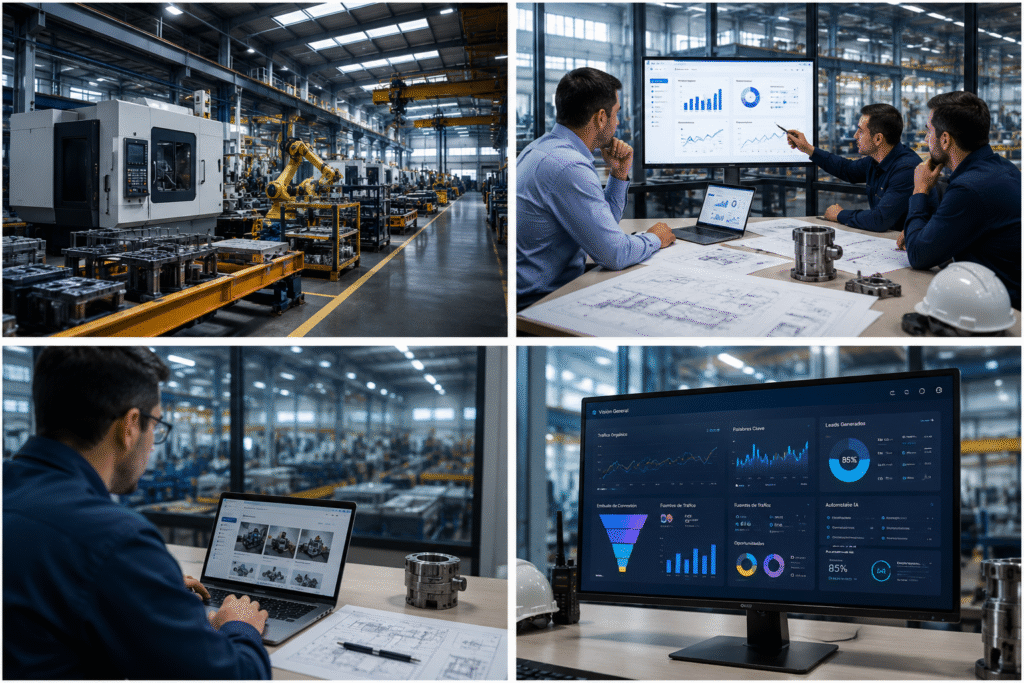
An effective strategy doesn’t rely on a single tactic.
The best results come from multiple elements working together toward the same objective.
| Strategy | Purpose |
|---|---|
| SEO | Increase Google visibility and attract qualified organic traffic. |
| High-converting website | Turn website visitors into qualified business opportunities. |
| Industry-focused content | Answer buyer questions and build trust throughout the purchasing journey. |
| Marketing automation & AI | Improve response times and streamline lead management. |
| Analytics | Measure performance and continuously optimize results. |
Each of these components plays a different role, but together they create a system capable of generating qualified B2B leads consistently.
How We Build Digital Marketing Strategies at Pixel Cap
At Pixel Cap, we understand that every industrial company has unique challenges, markets, and business goals.
That’s why we don’t believe in one-size-fits-all marketing strategies.
Before launching any initiative, we analyze your business, your target audience, and your competitive landscape to develop a strategy aligned with your commercial objectives.
Our process typically follows these steps.
Business Analysis

↓

Keyword & Competitor Research

↓

Website Optimization

↓

SEO & Content Strategy

↓

Implementation & Performance Monitoring

↓

Continuous Optimization
This structured approach ensures that every marketing effort works together to increase online visibility, attract qualified prospects, and generate sustainable business growth.
How Can Pixel Cap Help You Build a Digital Marketing Strategy?
Building a successful digital marketing strategy for industrial companies requires technical expertise, ongoing analysis, and a strong focus on measurable business outcomes.
At Pixel Cap, we help industrial businesses strengthen their online presence through customized strategies designed to attract high-intent buyers and generate qualified B2B leads.
Our services include:
| Service | How It Benefits Your Business |
|---|---|
| SEO | Improves Google rankings and increases qualified organic traffic. |
| Website optimization | Turns your website into a powerful lead generation tool. |
| Content marketing | Positions your company as a trusted industry authority. |
| AI & marketing automation | Streamlines sales processes and improves customer engagement. |
| Analytics & continuous optimization | Uses data-driven insights to maximize long-term performance. |
Our goal isn’t simply to increase website traffic.
Our goal is to turn that traffic into real business opportunities.
Ready to Generate More Qualified B2B Leads?
If your company wants to improve its Google visibility and implement a results-driven digital marketing strategy, Pixel Cap is here to help.
We’ll analyze your current digital presence, identify growth opportunities, and develop a customized strategy tailored to your business objectives.
👉 Schedule a consultation with our team and discover how digital marketing can help your industrial company generate more qualified B2B leads.
Frequently Asked Questions About Digital Marketing for Industrial Companies
What Is Digital Marketing for Industrial Companies?
Digital marketing for industrial companies combines strategies such as SEO, content marketing, artificial intelligence, and marketing automation to increase online visibility, attract qualified B2B leads, and generate long-term business opportunities.
How Long Does It Take to See Results?
The timeline depends on your business goals and the strategies implemented. SEO typically delivers progressive results over the medium to long term, while paid advertising can generate visibility and leads much sooner.
Can Digital Marketing Work for Any Industrial Company?
Yes. Manufacturers, distributors, engineering firms, machinery suppliers, and other B2B organizations can all benefit from a digital marketing strategy tailored to their industry and sales process.
Which Is More Important for Industrial Companies: SEO or Paid Advertising?
SEO and paid advertising work best together.
SEO builds long-term organic visibility and sustainable lead generation, while paid advertising helps accelerate growth by reaching potential customers more quickly when immediate results are needed.